

Objectives
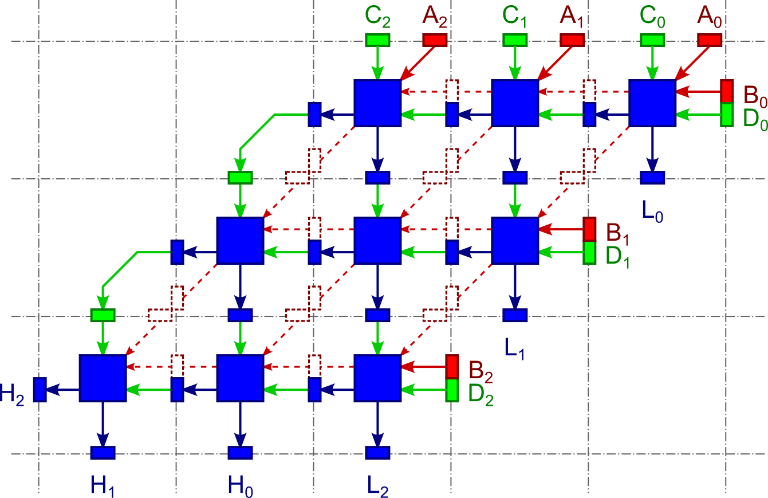
The primary aim of EDGE-SA is to investigate the potential suitability and applications of systolic arrays as acceleration solutions for data processing challenges that demand extensive computation at the edge, especially crucial for resource-constrained devices. These technologies can serve as supporting mechanisms alongside existing technologies like artificial neural networks.
To enhance and validate the research, a set of real-world application contexts have been considered, such as indoor tracking, digital health, and miscellaneous artificial intelligence applications. These applications have considerable computational demands that can be challenging for low-power edge devices, typically requiring more power-hungry processors or offloading the computation to an external server, both of which increase the cost and power consumption of the solution.
The use of systolic array topologies as digital signal processing circuits offers high parallel processing capacity with low operation frequency requirements, potentially reducing the cost of the device and its power consumption. Additionally, the great scalability of systolic arrays offers a great compromise between problem size and performance, permitting a high rate of computational power for small problem sizes while allowing larger problems to be implemented as well.
NVISION role:
- Explore new applications for SA-based data processing topologies.
- Investigate alternative SA topologies.
- Develop and simulate SA topologies.
- Develop and implement hardware accelerators that leverage the computing capacity of an SA to accelerate common computational tasks.
- Measure and verify the success of the solution on a Digital Health application.
Funding:
The EDGE-SA project is funded by the Marie Skłodowska-Curie Actions Postdoctoral Fellowships (MSCA-PF) programme (HORIZON-MSCA-2023-PF-01-01, Grant No. 101155367).

Funded by the European Union. Views and opinions expressed are however those of the author(s) only and do not necessarily reflect those of the European Union or the European Research Executive Agency. Neither the European Union nor the European Research Executive Agency can be held responsible for them.